Schedule a Call
Ready to Upgrade Your Process Operations?
Ready to Upgrade Your Process Operations?
Learn how additive manufacturing alters titanium alloy microstructure and fatigue, and how these changes influence monitoring signals in aerospace systems.
In aerospace and defense manufacturing, monitoring systems are only as reliable as the material assumptions behind them. For decades, inspection thresholds, vibration signatures, and fatigue indicators were calibrated around wrought and forged titanium. Additive manufacturing disrupts that baseline. The alloy name may be the same, but the material behavior is not.
Many teams encounter this gap late in qualification or early in service. A component meets dimensional and chemistry requirements, yet monitoring data begins to drift. Acoustic responses shift. Fatigue indicators no longer track as expected. NDT signals raise questions that traditional defect models cannot fully explain.
This blog examines how additive manufacturing alters the microstructure and defect morphology, and how these changes affect monitoring and inspection signals in critical systems.
Titanium has become a structural material of choice in aerospace because it addresses multiple engineering constraints simultaneously. Common aerospace applications include:
As production costs decline, titanium’s role in aerospace continues to expand beyond traditional applications.
Also Read: Aircraft Alloys: Properties, Types, and Aerospace Engineering Insights
These applications set clear performance expectations. The different additive manufacturing changes how titanium reaches those requirements, starting with how the material is formed.
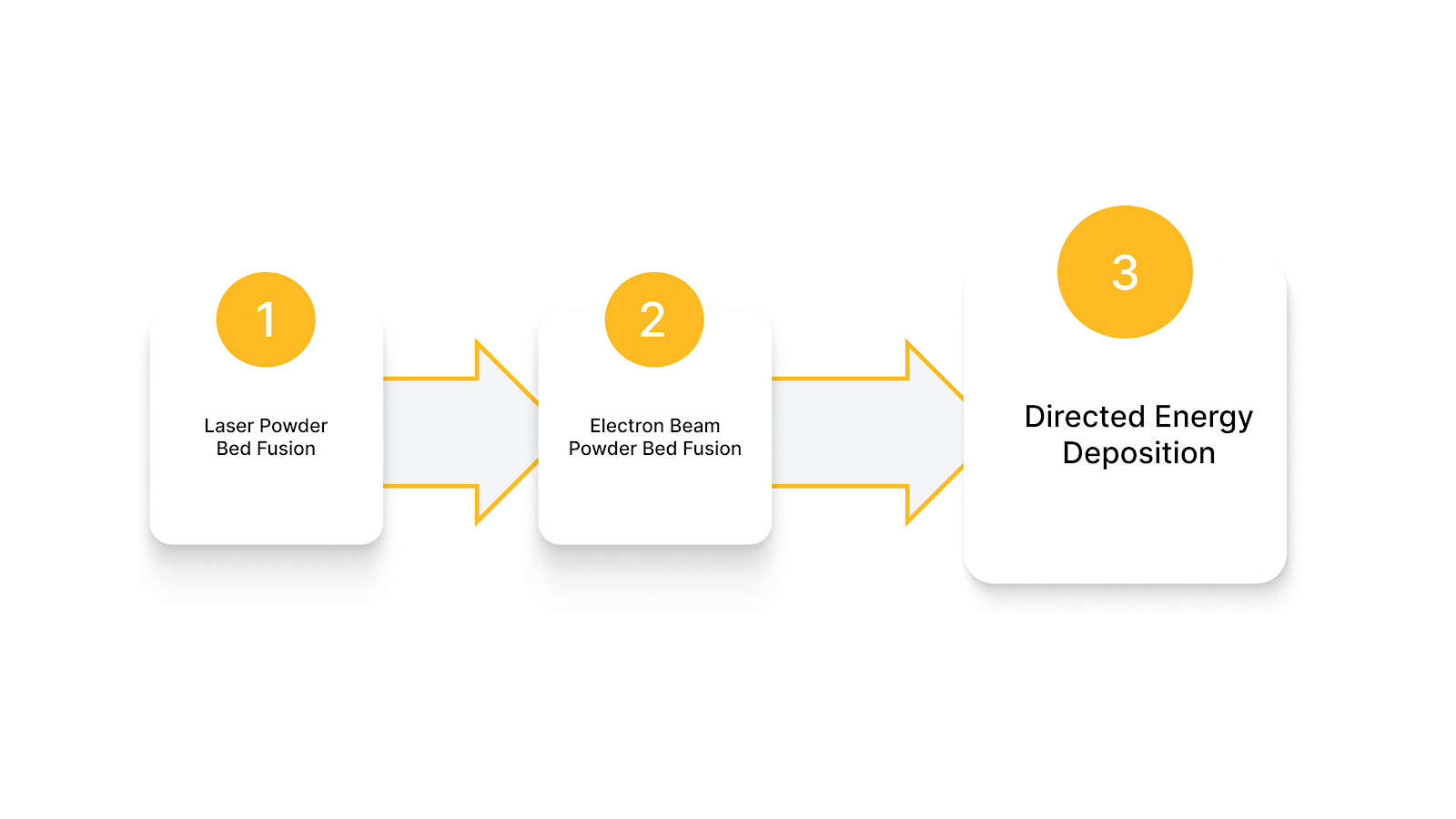
In aerospace applications, additive manufacturing is not a single material condition. Each process imposes a distinct thermal and solidification history on titanium alloys, and those differences directly control microstructure, defect formation, and fatigue behavior.
The most widely used process for aerospace titanium components, rapid melting and solidification produce fine microstructures and high cooling rates, often resulting in martensitic alpha-prime phases in Ti-6Al-4V.
While this can increase strength, it also introduces residual stress, anisotropy, and sensitivity to lack-of-fusion defects. These characteristics influence fatigue crack initiation and can distort ultrasonic and acoustic monitoring signals if forged baselines are applied.
Operating in a vacuum environment at high build temperatures, this reduces oxidation and residual stress while promoting a more stable alpha-beta microstructure. However, EBPBF parts exhibit distinct surface roughness and internal feature morphology, which affects both fatigue life and non-destructive inspection responses.
This produces larger melt pools and slower cooling rates. Titanium components manufactured by DED typically show coarser grains, strong directional properties, and localized thermal gradients. These features influence stiffness, vibration behavior, and fatigue response, particularly in large structural components and repaired parts.
For titanium alloys, the additive process selected determines mechanical performance and how monitoring, inspection, and qualification data should be interpreted throughout the component lifecycle.
Those process differences first show up at the microstructural level, where cooling rates and thermal history shape how the alloy behaves.
Additive manufacturing produces titanium alloys through thermal conditions that do not exist in forging or rolling. Those differences are immediately evident in grain structure, phase balance, and residual stress.
Layer-by-layer deposition creates rapid heating and cooling cycles, resulting in steep thermal gradients throughout the build height. Solidification under non-equilibrium conditions produces microstructures not observed in wrought titanium. Prior β grains often grow epitaxially in the build direction, creating elongated, columnar grain structures.
Many AM titanium alloys form α′ martensite due to high cooling rates during solidification. This martensitic structure increases strength but reduces ductility compared to forged α+β microstructures. Post-processing, such as heat treatment or HIP, can partially transform martensite into lamellar α+β phases.
Additive manufacturing enables site-specific microstructures within a single component. Local variations in thermal gradient and solidification rate influence whether grains grow columnar, equiaxed, or in mixed morphologies.
In some alloys, lamellar colonies form within β grains, while secondary α phases disperse at finer scales. These localized features introduce directional mechanical behavior that does not average out across the part.
Microstructural outcomes are tightly coupled to process settings. Laser power and scan speed control the melt pool geometry and cooling rate. Hatch spacing and layer overlap influence remelting and grain continuity between layers. Powder feed rate and energy density affect porosity, lack-of-fusion defects, and chemical homogeneity across the build.
Repeated thermal cycling generates tensile residual stresses, particularly near free surfaces and scan terminations. Strong crystallographic texture often develops along the build direction, reinforcing anisotropic elastic and fatigue behavior. Residual stress magnitude varies with scan strategy, build geometry, and substrate preheating, contributing to part-to-part variability even under controlled conditions.
Compared to forged titanium, AM alloys exhibit greater microstructural variability. That variability is central to understanding fatigue behavior, inspection response, and the interpretation of monitoring signals in critical aerospace systems.
Also Read: Alloy Forge Explained: Proven Techniques & Applications in 2026
Microstructure alone does not tell the full story. The types of defects introduced during additive manufacturing play an equally important role.
Additive manufacturing introduces defect types that differ fundamentally from those seen in wrought or forged titanium. These defects are not always critical individually, but their distribution and morphology matter. Common process-induced anomalies include:
Defects in forged titanium are typically fewer, more uniform, and better understood within existing lifing and inspection models. That predictability is largely absent in additively manufactured parts unless defect behavior is explicitly addressed during design, processing, and qualification.
Mechanical Impact In Service
From a mechanical standpoint, these defects act as early fatigue crack initiators rather than benign inclusions. Sharp pore geometry and layer boundaries concentrate stress, accelerating crack initiation and growth under cyclic loading. The result is fatigue behavior that becomes orientation-dependent and less predictable using forged-material assumptions.
Post-processing, alloy selection, and process control can improve outcomes, but only when defect behavior is fully accounted for during design and qualification.
When defect behavior drives fatigue life and inspection confidence, titanium sourcing and processing must align with aerospace standards from the start.
Aero-Vac Alloys and Forge supplies fully traceable titanium to specifications such as AMS 4911, AMS 6930, MIL-T-9046, MIL-T-9047, with in-house forging to DMS 1881 and heat treatment per AMS 2801 and MIL-H-81200, helping teams qualify additively manufactured titanium with fewer unknowns and less program risk.
Once these features are present in the material, they influence how the part responds to load and how inspection systems interpret what they see.
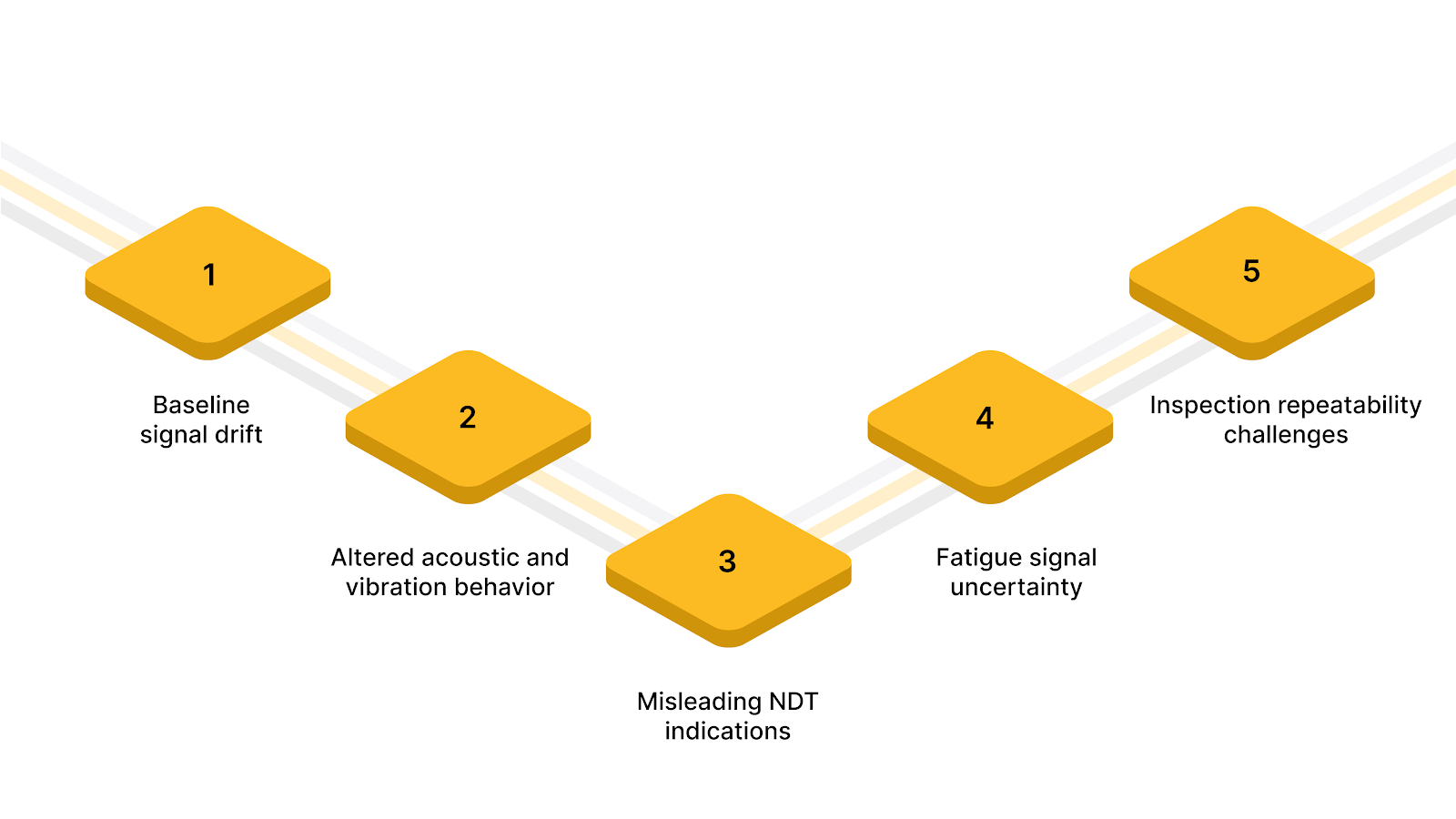
Most aerospace monitoring and inspection methods were developed around the predictable behavior of forged and rolled titanium. Additively manufactured titanium introduces material variability that shifts those expectations in subtle but important ways.
Key impacts engineers and inspection teams should account for include:
These effects require engineers to recalibrate assumptions, adjust acceptance criteria, and align inspection methods with how additively manufactured titanium actually behaves in service.
Also Read: The Real Effect of Alloying Elements on Steel Hardenability
Managing those risks depends on decisions made well before inspection begins, starting with material supply, processing, and traceability.
Understanding how additive manufacturing affects the performance of titanium alloys is only useful if the material supply and processing support that reality on the shop floor. Aero-Vac Alloys & Forge supports aerospace and defense teams by providing:
If your team is qualifying additively manufactured titanium or reassessing inspection baselines, Aero-Vac helps reduce material risk before it reaches production.
Additive manufacturing has expanded what is possible with titanium alloys, but it has also challenged long-standing assumptions about material behavior, inspection baselines, and fatigue performance. The changes introduced at the microstructural level carry through qualification, monitoring, and long-term service life.
Certified material supply, controlled processing, and full traceability play a direct role in how titanium behaves under load and how it is interpreted by monitoring systems.
Aero-Vac Alloys & Forge supports aerospace and defense programs with certified titanium alloys, integrated processing, and compliance with aerospace-grade standards.
Contact us to explore Aero-Vac Alloys & Forge’s certified titanium alloys and processing capabilities designed to reduce material risk early in qualification.
1. Why do monitoring signals differ between additively manufactured and forged titanium parts?
Additive manufacturing produces distinct microstructures and defect distributions that alter acoustic emissions, vibration signatures, and NDT responses, shifting baseline signals compared to forged titanium.
2. Can standard inspection criteria be used for additively manufactured titanium?
Not directly. Inspection thresholds tuned for wrought or forged material often miss or misinterpret AM-specific features, such as layer interfaces and distributed porosity. Calibration to AM-specific baselines is recommended.
3. How does material supply quality impact additive titanium qualification?
Certified and traceable material supply ensures predictable fatigue behavior and inspection results. Without it, qualification and monitoring systems may generate inconsistent or misleading signals.
4. What material specifications should aerospace teams request for AM titanium supply?
Request aerospace-grade titanium with full traceability to mill test reports and processing aligned to standards such as AMS 4911, AMS 6930, MIL-T-9046, and MIL-T-9047.