Schedule a Call
Ready to Upgrade Your Process Operations?
Ready to Upgrade Your Process Operations?
Learn how stainless steel products are manufactured, from raw materials and melting to forming, finishing, and quality checks used in industrial applications.
Stainless steel is often treated as a finished commodity. A grade number, a size, a delivery date. But for procurement and engineering teams, problems rarely come from the specification alone. They come from how the material was melted, formed, heat-treated, and finished long before it reached the floor.
When process steps vary, the impact shows up as inconsistent machinability, surface defects, corrosion issues, or extra time spent during inspection and qualification. For sourcing teams, it adds supplier risk and documentation gaps that surface late. For manufacturing engineers, it turns into avoidable rework and schedule pressure.
This blog breaks down how stainless steel products are manufactured, from raw materials and melting through forming, heat treatment, finishing, and quality control. Let’s jump in.
In industrial and aerospace applications, stainless steel is selected for its corrosion behavior at the metallurgical level, not because it is simply labeled “rust resistant.” Its performance depends on the formation and stability of a naturally developing passive chromium oxide layer (Cr₂O₃) at the surface.
This passive layer is extremely thin but continuous and self-healing. When stainless steel is cut, machined, or lightly damaged, chromium in the alloy reacts with oxygen, rapidly reforming the oxide barrier. That response is intrinsic to the material. It does not rely on coatings, platings, or surface finishes to remain effective.
For manufacturing teams, corrosion resistance is not guaranteed solely by alloy selection. Processing steps such as melting, hot working, heat treatment, pickling, and passivation all influence the uniformity and stability of the passive layer. Contamination, improper thermal exposure, or surface defects can disrupt this layer, creating sites for localized corrosion.
Stainless steel performance depends on the raw materials selected at the start. Here’s a glance.
The performance of any specialty alloy is dictated by its "melt recipe." While iron is the base, the specific blend of raw materials determines how the steel will behave under extreme stress, heat, or chemical exposure.
Manufacturing engineers and procurement managers prioritize these key inputs to ensure the final product meets AMS, BMS, or MIL-spec requirements:
These controlled chemistries define stainless steel grades. Common examples include:
From a manufacturing standpoint, raw material control sets the foundation. Every downstream step, melting, forming, heat treatment, and finishing, builds on these initial chemistry decisions.
Also Read: 11 Best Tungsten for TIG Welding Stainless Steel in 2026
Once the materials are defined, the focus shifts to the production of stainless steel.

Stainless steel manufacturing is a controlled sequence of metallurgical and mechanical steps. While the final processing varies by grade and product form, the early stages follow a common industrial path that defines performance downstream.
Stainless steel production begins by melting a controlled mix of stainless scrap, ferrous alloys, and alloying elements in an electric arc furnace (EAF).
The objective is not the final composition. It is to create a molten alloy that can be refined with precision.
Carbon plays a dual role. It contributes strength, but excess carbon reduces corrosion resistance and creates welding risks.
Refining via AOD or VOD is critical for preventing intergranular corrosion. By reducing carbon to 'L-grade' levels (under 0.03%), we prevent the formation of chromium carbides during welding, a phenomenon known as sensitization that can lead to catastrophic part failure in corrosive environments.
After carbon adjustment, the melt is brought to its final chemical balance.
Uniformity across the batch is critical. Variations here create inconsistent mechanical and corrosion behavior later.
Once chemistry is set, the molten steel is cast into primary shapes that define downstream processing routes.
Common formats include:
Each form is tagged for traceability. From this point forward, mechanical processing dominates.
Also Read: Best Drill Bits for Stainless Steel Bolts – Expert Picks
Hot rolling reshapes the cast steel above its recrystallization temperature.
Hot working establishes basic dimensions and internal grain flow.
Cold rolling occurs below recrystallization temperature and focuses on dimensional accuracy.
Cold work improves precision but introduces internal stress that must be addressed.
Annealing restores balance after mechanical deformation.
Improper annealing results in residual stresses that cause the material to 'walk' or warp during heavy CNC milling.
Thermal processing creates oxide scale on the surface.
This step is functional, not cosmetic.
Material is cut to size and prepared for delivery.
The steel is now in its final, usable form.
For stainless steel supplied in bar, plate, sheet, tube, or forging form, with AS9100 traceability and value-added processing like cutting, heat treating, and near-net delivery, Aero-Vac Alloys & Forge supports aerospace and defense programs where metallurgical consistency and regulatory compliance are non-negotiable.
This manufacturing process only works when the material supply and processing are tightly controlled.
When stainless steel performance, certification, and delivery timelines matter, Aero-Vac supports manufacturers with materials and processing that align with how stainless steel is actually made and used.
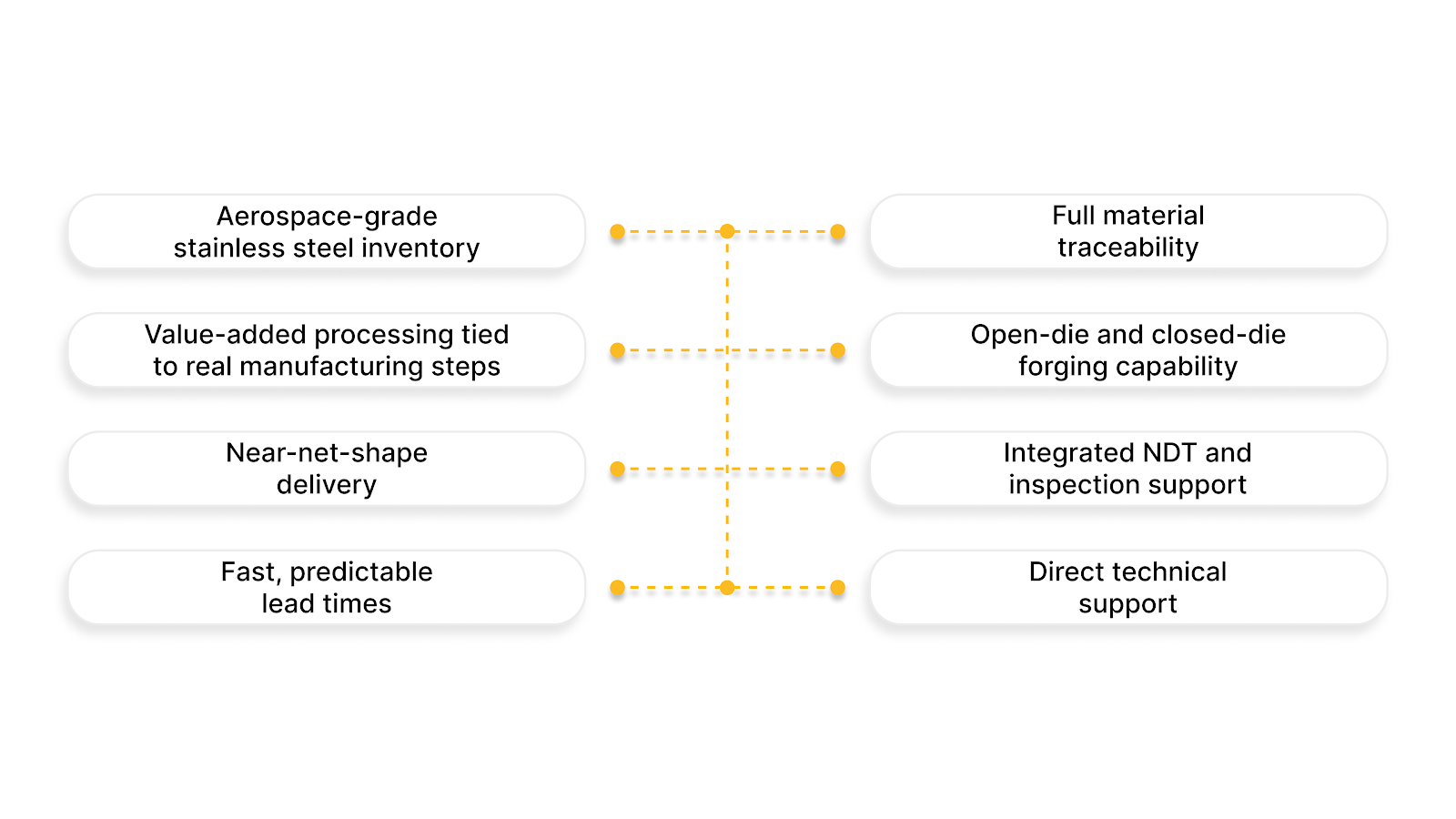
Aero-Vac functions as a manufacturing distributor, not a broker. That difference shows up in control, speed, and accountability.
Stainless steel manufacturing is a controlled, multi-stage process where each decision shapes performance, consistency, and long-term reliability. From melting and refining to rolling, heat treatment, and finishing, the path from raw material to finished form determines corrosion resistance, machinability, and service life.
Aero-Vac Alloys & Forge supports long-term production lifecycles with certified stainless steel, value-added processing, and the traceability required for mission-critical manufacturing.
Explore Aero-Vac’s stainless steel alloys and processing services to source material that arrives ready to perform, qualify, and move straight into production.
1. How are stainless steel products manufactured?
Stainless steel products are made through melting, refining, forming, heat treatment, and finishing. Each stage controls strength, corrosion resistance, and dimensional consistency for the final application.
2. Which process is used to make stainless steel?
Stainless steel is typically produced using an electric arc furnace, followed by AOD or VOD refining. The material is then cast, rolled, heat-treated, and finished.
3. How do manufacturers control stainless steel composition?
After melting, carbon and impurities are reduced using controlled oxygen processes. Alloying elements are adjusted during tuning to meet specific grade requirements and standards.
4. How is stainless steel shaped into usable products?
Molten steel is cast into slabs, billets, or blooms. These forms are hot rolled, cold worked, or forged into sheets, plates, bars, tubes, or custom shapes.
5. Why are heat treatment and finishing important in stainless steel manufacturing?
Heat treatment relieves internal stress and restores ductility. Finishing removes scale and creates the oxide layer that gives stainless steel its corrosion resistance.