Your one-stop metals shop offering value-added services on time!
Thank you! Your submission has been received!
Oops! Something went wrong while submitting the form.
Trusted by 100+ Growth Leaders.
Welding defects and inconsistent arc stability can lead to production delays, rework, and added operational costs.
The impact of selecting an unsuitable tungsten for TIG welding stainless steel is often underestimated, yet it can result in reduced weld quality, increased electrode wear, and inconsistent performance.
In industries such as aerospace, medical, and defense, these issues can affect schedules and cost control. So, it's crucial to select the appropriate tungsten that helps support stable arc performance and consistent, high-quality weld results.
In this blog, you’ll explore the best tungsten options for stainless steel welding and how to match them to your specific needs, ensuring cleaner, more reliable welds every time.
Key Takeaways:
Match Tungsten to Amperage: Lanthanated for low-medium, thoriated for high amperage welding.
Choose the Right Composition: Lanthanated and ceriated offer stable arcs, whereas thoriated provides high heat resistance but is radioactive.
Ensure Arc Stability: Use tungsten types like lanthanated or ceriated for better arc stability and less contamination.
Select Based on Material Thickness: Use smaller electrodes for thin materials, larger ones for thicker sections to manage heat effectively.
6 Key Factors to Consider When Choosing Tungsten for TIG Welding Stainless Steel
When selecting tungsten for TIG welding stainless steel, choosing the right option is essential for maintaining consistent weld quality, reducing defects, and improving overall production efficiency.
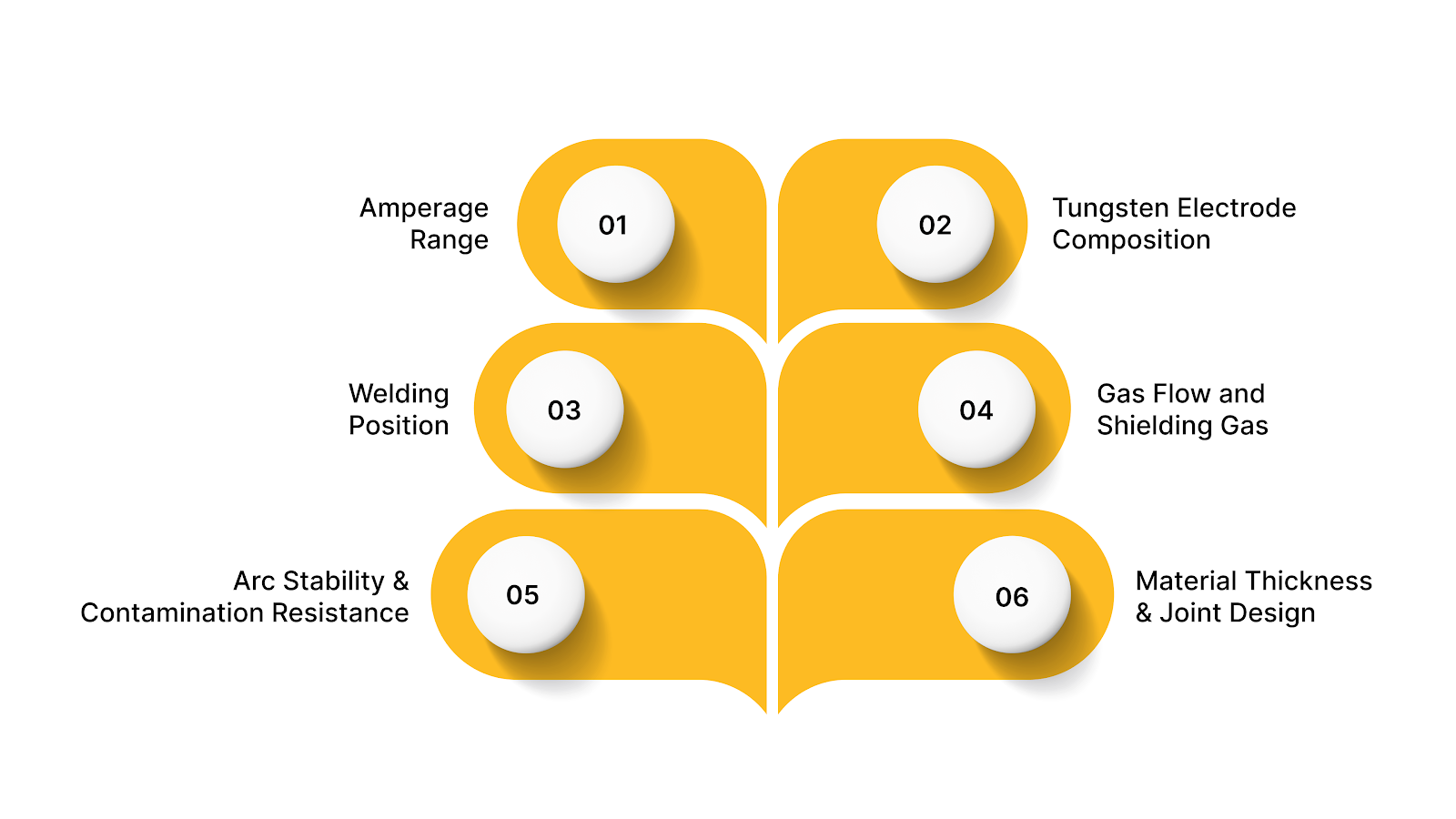
Below are six key factors to consider when selecting tungsten for this application.
1. Amperage Range
Tungsten selection is closely tied to the amperage range required for welding stainless steel. Using an unsuitable tungsten type can lead to arc instability, poor penetration, or premature electrode wear.
What You Need to Know:
For low to medium amperage welding (under 150 amps), lanthanated tungsten offers stable arc performance at lower currents.
For higher amperage applications (above 200 amps), thoriated tungsten or pure tungsten performs better due to higher heat tolerance.
Key Insight: Match the tungsten’s amperage capability with your welding machine’s output to maintain stability, improve weld quality, and extend electrode life.
2. Tungsten Electrode Composition
The composition of the tungsten electrode influences arc stability, contamination risk, and heat resistance during welding.
What You Need to Know:
Lanthanated Tungsten (WL20): Suitable for a wide range of applications, offering consistent arc stability and long service life.
Thoriated Tungsten (WT20): Known for high heat resistance and stable arcs, though it is radioactive.
Pure Tungsten (WP): Best suited for low-amperage, precision welding tasks.
Ceriated Tungsten (WC20): Non-radioactive, performs well at low to medium amperage, and delivers a clean, stable arc.
Key Insight: Select the electrode based on amperage requirements and work environment. Non-radioactive options, such as lanthanated or ceriated tungsten, offer safer handling while maintaining reliable arc performance.
3. Welding Position
Welding position affects how the tungsten behaves during operation, making certain types more suitable for specific orientations.
What You Need to Know:
For flat and horizontal welds, lanthanated or thoriated tungsten performs consistently.
For vertical and overhead welds, maintaining arc stability becomes more critical.
Key Insight: In vertical or overhead positions, choose tungsten that offers precise control and stable arc behavior, such as pure tungsten, to improve consistency.
4. Gas Flow and Shielding Gas
Shielding gas protects the weld pool and prevents tungsten contamination. Proper gas flow also helps control heat and oxidation.
What You Need to Know:
Argon is commonly used for TIG welding stainless steel, while hydrogen blends can improve results on thinner materials.
Consistent gas flow is essential to avoid contamination and maintain a stable arc.
Key Insight: Adjust gas flow and tungsten selection together to meet shielding requirements and ensure clean, stable weld conditions.
5. Arc Stability and Contamination Resistance
Stable arc performance is essential for producing consistent, high-quality welds, especially when working with stainless steel.
What You Need to Know:
Lanthanated and ceriated tungsten types offer improved arc stability and reduced contamination risk.
Contaminated tungsten can introduce weld defects such as porosity or inclusions.
Key Insight: Prioritize tungsten options that maintain arc stability and resist contamination. Cleaner electrodes lead to smoother arcs and better weld quality.
6. Material Thickness and Joint Design
Material thickness and joint configuration directly affect heat input requirements, influencing the choice of tungsten size and type.
What You Need to Know:
Thicker stainless steel requires higher amperage and larger tungsten electrodes to distribute heat effectively.
Thinner materials benefit from smaller electrodes, such as pure tungsten, operated at lower amperage for better heat control.
Key Insight: Choose tungsten based on material thickness and joint design to manage heat input effectively, using larger electrodes for heavier sections and smaller ones for detailed work.
Once you understand the factors that affect tungsten selection, a quick comparison makes it easier to see which options work best for stainless steel.
Quick Comparison of Best Tungsten for TIG Welding Stainless Steel
Tungsten Type
Performance Strength
Best For
Lanthanated Tungsten (2% La₂O₃)
Stable arc, low burn-off, consistent re-strike
General stainless steel welding in aerospace, medical, defense
Ceriated Tungsten (2% CeO₂)
Smooth arc start, minimal contamination
Thin-gauge stainless steel, precision welding
Zirconiated Tungsten (0.8% ZrO₂)
High current stability, deep penetration
High-amperage welding on thick stainless steel sections
Pure Tungsten (WP, ~99.5%)
Clean arc with minimal contamination at low currents
Low-current, ultra-clean welds on thin materials
Rare-Earth Multi-Doped Tungsten
Broad current range, reliable re-strike
Variable production environments requiring stable arc behavior
Heavy-Duty Lanthanated Tungsten
High current capacity, extended electrode life
Long production runs, heavy-duty welding
AWS Class 2 Tungsten Electrodes
Reliable, consistent arc quality
Standard industrial welding where consistency and compliance are key
AWS Class 3 Tungsten Electrodes
Better arc stability and cleaner welds than Class 2
Precision fabrication and tight-tolerance work
Gold-Tinted Tungsten (Process-Enhanced)
Improved arc ignition, reduced wear
Production environments with frequent arc starts and stops
Silver-Tinted Tungsten (Workhorse Option)
Stable arc, even heat distribution
General TIG welding across multiple tasks
Specialty Coated Tungsten
Longer life, improved arc starts
High-precision or high-reliability applications requiring enhanced ignition and longevity
After reviewing the comparison, it becomes easier to take a closer look at the top tungsten options recommended by experts.
11 Best Tungsten for TIG Welding Stainless Steel: Expert Pick
Selecting the right tungsten electrode for TIG welding stainless steel directly affects arc stability, weld integrity, defect reduction, and overall cost of use. Below are the 11 best tungsten for TIG welding stainless steel in 2026.
1. Lanthanated Tungsten (2% La₂O₃)
Material Composition: Tungsten doped with approximately 2% lanthanum oxide.
Durability: Delivers strong arc stability and reliable re-strike performance with low electrode burn-off. Performs consistently across a wide amperage range.
Limitations: Slightly higher cost than pure tungsten and less suited for ultra-low current precision work without adjustment.
Best For: General stainless steel TIG welding in aerospace, medical, and defense applications. Well-suited for environments that require consistent arc behavior and flexibility across current ranges.
2. Ceriated Tungsten (2% CeO₂)
Material Composition: Tungsten alloyed with approximately 2% cerium oxide.
Durability: Provides reliable low-current arc starts, smooth arc behavior, and minimal contamination in low to medium amperage ranges.
Limitations: Not well-suited for high-amperage or thick-section welding due to limited penetration at higher currents.
Best For: Thin-gauge stainless steel, precision assemblies, and applications where heat control is critical, such as medical device fabrication.
3. Zirconiated Tungsten (0.8% ZrO₂)
Material Composition: Tungsten alloyed with approximately 0.8% zirconium oxide.
Durability: Offers strong resistance to contamination and maintains arc stability at high current levels, with slower burn-off during extended welding cycles.
Limitations: Less effective at very low amperages and requires consistent shielding gas control.
Best For: High-amperage TIG welding on thicker stainless steel sections and structural components where deep penetration and stable arc performance are required.
4. Pure Tungsten (WP, ~99.5%)
Material Composition: Near-pure tungsten with minimal alloying elements.
Durability: Produces a clean, defined arc with minimal contamination at low current levels.
Limitations: Limited current capacity and accelerated wear at higher amperages.
Best For: Low-current, ultra-clean welds on very thin materials where precision is more important than output.
5. Rare-Earth Multi-Doped Tungsten
Material Composition: Tungsten doped with multiple rare-earth oxides, such as lanthanum and cerium.
Durability: Supports a broader operating current range with improved arc re-strike reliability compared to single-dopant electrodes.
Limitations: Higher cost and performance variability depending on the dopant combination.
Best For: Variable production environments where welding parameters change frequently, and stable arc behavior is required.
Material Composition: Tungsten electrodes with engineered surface coatings designed to improve arc starts and reduce oxidation.
Durability: Coatings can enhance electrode life and arc consistency under certain conditions.
Limitations: Performance varies by coating type and application; benefits depend on operating parameters.
Best For: High-precision or high-reliability applications where improved ignition and electrode longevity justify a higher cost.
Finding dependable, high-performance stainless steel for your project can be challenging.Aero-Vac provides certified, fully traceable specialty metals that deliver the quality you need for precise welding applications.
With an extensive inventory and fast turnaround, Aero-Vac serves the aerospace, defense, and medical sectors, supplying materials designed for the most exacting standards.
After reviewing the top tungsten picks, it’s helpful to understand the common mistakes that can affect welding results and equipment performance.
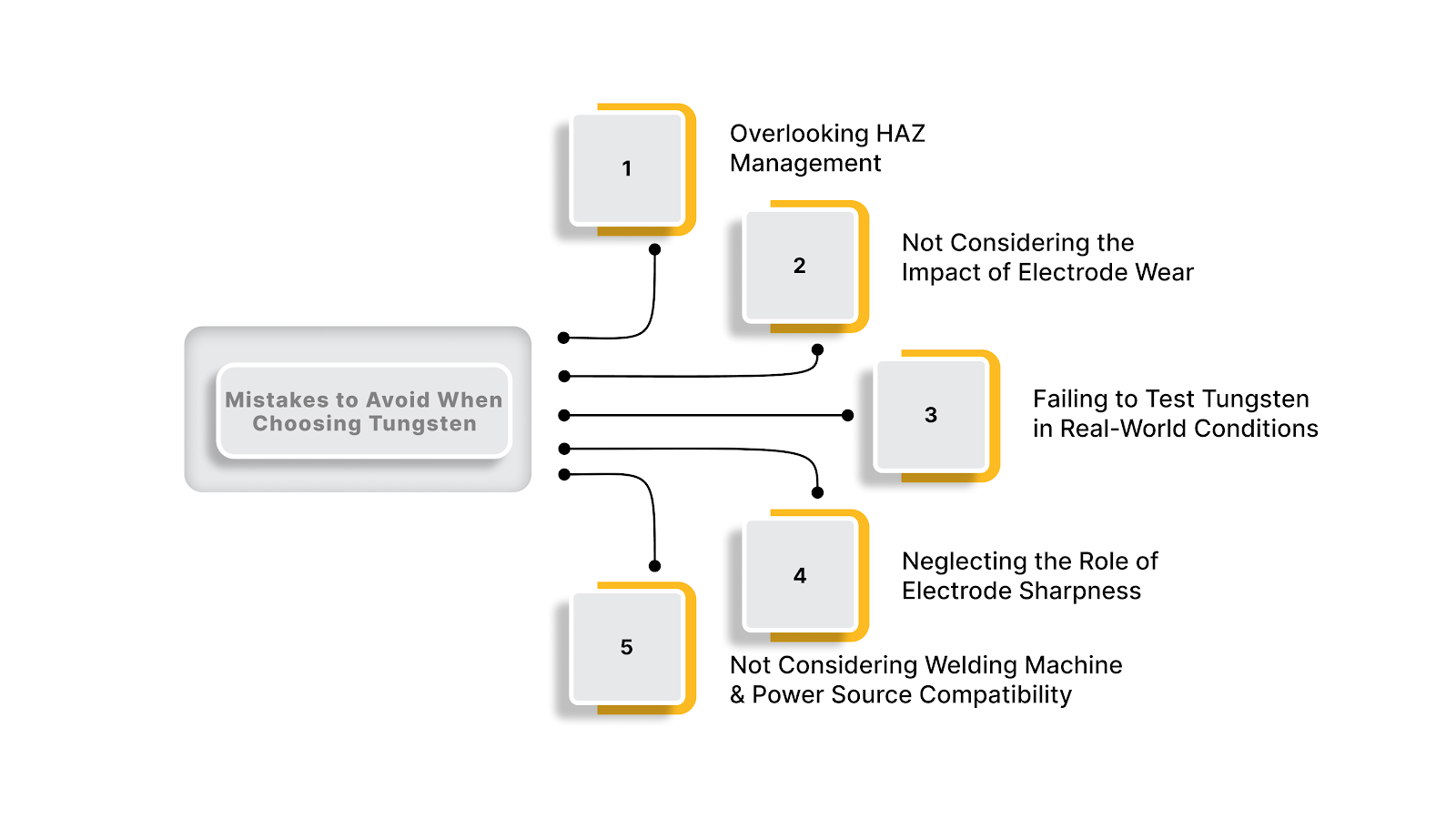
5 Common Mistakes to Avoid When Choosing Tungsten for TIG Welding Stainless Steel
Choosing the right tungsten for TIG welding stainless steel is important for maintaining weld quality, minimizing production downtime, and controlling material costs. However, engineers and procurement teams often encounter common challenges when selecting tungsten.
1. Overlooking Heat-Affected Zone (HAZ) Management
Failing to consider the heat-affected zone can lead to distortion, oxidation, or reduced material strength. Improper tungsten selection can intensify these issues and compromise weld quality.
Solution: Choose a tungsten electrode that supports controlled heat input within the HAZ. Lanthanated tungsten helps manage heat distribution more effectively and reduces the risk of overheating.
2. Not Considering the Impact of Electrode Wear
Overlooking how tungsten wear affects weld quality can lead to uneven arc performance and inconsistent results. Continued use of worn electrodes increases the risk of defects.
Solution: Inspect tungsten electrodes regularly and replace them as needed. Maintaining a properly shaped, defect-free tip helps ensure stable arc performance.
3. Failing to Test Tungsten in Real-World Conditions
Relying only on theoretical specifications without testing tungsten in actual welding conditions can result in underperformance. Laboratory data alone may not reflect real job-site variables.
Solution: Test the selected tungsten under real operating conditions and adjust as needed based on observed performance to confirm suitability for the application.
4. Neglecting the Role of Electrode Sharpness
Using a dull or improperly sharpened tungsten electrode leads to poor arc stability and difficulty maintaining a consistent weld pool. This increases the risk of arc wandering and contamination.
Solution: Apply proper sharpening techniques to maintain a clean, sharp tungsten point. Correct electrode geometry improves arc control, heat focus, and weld consistency.
5. Not Considering Welding Machine and Power Source Compatibility
Failing to account for how the welding machine and power source interact with the tungsten electrode can result in unstable arcs, inefficient energy use, and speed up electrode wear.
Solution: Align tungsten selection with the welding machine’s power output and settings. Ensure the equipment delivers stable current within the required range to maintain consistent arc performance and heat input.
Avoiding these common mistakes highlights the importance of working with Aero-Vac, which understands stainless steel quality and performance requirements.
Why Choose Aero-Vac for High-Quality Stainless Steel Solutions?
Aero-Vac provides specialty metals and custom forgings for industries where material quality and reliability are essential.
By focusing on supply chain risk management, Aero-Vac supplies certified, traceable materials that meet established industry standards.
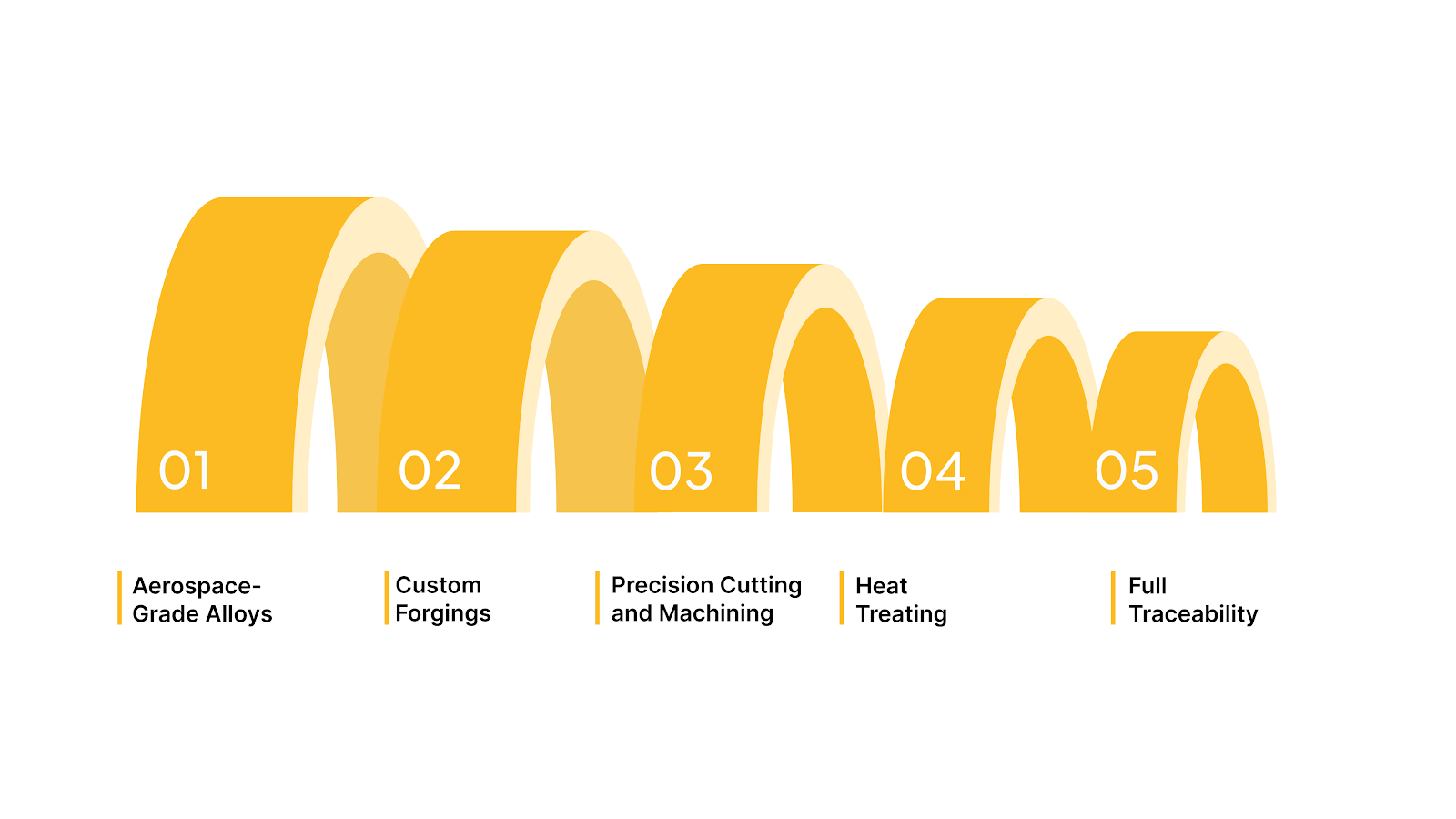
What Aero-Vac Offers:
Aerospace-Grade Alloys: More than 150 alloy types, including Inconel 718,17-4PH, and Ti-6Al-4V, certified to AMS and BMS standards.
Custom Forgings: Open- and closed-die forgings available in a range of sizes and configurations to meet specific requirements.
Precision Cutting and Machining: In-house capabilities support near-net-shape components while reducing scrap and lead times.
Heat Treating: Full-service heat treating to improve the performance characteristics of specialty metals used in critical applications.
Full Traceability: All materials are traceable to original mill test reports and supplied in compliance withAS9100 andISO 9001 standards.
Aero-Vac’s focus on quality control and delivery reliability supports stainless steel sourcing requirements across demanding industries.
Selecting the right tungsten for TIG welding stainless steel is vital for producing clean, precise welds. Common options like lanthanated, ceriated, and zirconiated tungsten work best for different welding tasks and amperage ranges, which makes it easier to choose the right electrode for the application.
Aero-Vac offers certified stainless steel materials that meet the performance and quality standards required for demanding applications. With a wide inventory and efficient processing, they help support project timelines and specification needs.
Need high-performance stainless steel solutions? Consult with our experts for tailored alloys and keep your project on track with quick, dependable delivery.
FAQs
Q1. What is the difference between lanthanated and ceriated tungsten electrodes?
A1. Lanthanated tungsten provides stable arc performance across a wide amperage range, making it suitable for general TIG welding applications. Ceriated tungsten performs best at low currents, offering smooth arc starts and reduced contamination, which makes it well-suited for precision welding tasks.
Q2. How does electrode diameter affect welding performance?
A2. Electrode diameter directly influences arc stability and heat distribution. Smaller electrodes, such as pure tungsten, are better suited for low-current, precision welding. In comparison, larger electrodes, such as lanthanated or thoriated tungsten, are required for higher-amperage welding of thicker materials.
Q3. Can tungsten electrodes be reused, and how should they be maintained?
A3. Tungsten electrodes can be reused, but wear over time can reduce arc stability and weld consistency. Regular inspection and proper sharpening are important to maintain performance.
Q4. Does shielding gas affect tungsten electrode performance?
A4. Shielding gas directly affects arc stability and weld quality. Argon is commonly used for TIG welding, while hydrogen blends may be used on thinner materials to improve arc performance and penetration. Proper gas flow also helps prevent tungsten contamination and oxidation.
Q5. How do I choose the right tungsten for stainless steel welding in specific environments, such as aerospace or medical?
A5. In aerospace and medical applications, ceriated or lanthanated tungsten is commonly used due to smooth arc starts and low contamination risk. Tungsten selection should also consider material thickness, amperage requirements, and joint design to ensure consistent results under controlled welding conditions.
Related articles
8 min read
How Stainless Steel Products Are Manufactured: A Detailed Process Guide
Learn how stainless steel products are manufactured, from raw materials and melting to forming, finishing, and quality checks used in industrial applications.
Steel Fabrication Quality Control: What Top Manufacturers Get Right
Learn how steel fabrication quality control works, from inspections and testing to traceability and process checks that reduce rework, delays, compliance risk.
Alloy Quality Control: How to Ensure Consistent Metal Performance
Learn the importance of alloy quality control in ensuring consistent metal performance. Discover techniques for maintaining alloy integrity in manufacturing.