
Major Special Alloys for Aerospace: Corrosion Resistance Explained

Learn about special alloys for aerospace applications, focusing on corrosion resistance and their role in enhancing performance in demanding environments.
Major Special Alloys for Aerospace: Corrosion Resistance Explained

ON THIS PAGE

Your one-stop metals shop offering value-added services on time!
Thank you! Your submission has been received!
Oops! Something went wrong while submitting the form.
Trusted by 100+ Growth Leaders.

In aerospace, where failure is not an option, selecting special alloys with superior corrosion resistance is crucial. Aerospace engineers face the constant challenge of ensuring materials withstand extreme conditions while maintaining performance and durability. 

Corrosion can lead to catastrophic failures, costly repairs, and production delays, impacting safety and mission success.

This blog addresses the pain points of alloy selection in aerospace applications, focusing on the critical issue of corrosion resistance. We’ll explore the best high-performance alloys and discuss the properties that make them ideal for the demanding aerospace environment.

Quick Recap

  • Top Alloys for Aerospace: Titanium, Inconel, and nickel alloys excel in strength and corrosion resistance, ideal for extreme aerospace conditions.
  • Corrosion Resistance: High-performance alloys like Inconel ensure reliability in harsh environments, resisting heat and corrosion in critical aerospace parts.
  • Machining Challenges: Aerospace alloys are difficult to machine due to their hardness, low thermal conductivity, and tendency to work harden, requiring specialized tools.
  • Critical Applications: Aerospace alloys are vital for components subjected to extreme stress, high temperatures, and corrosive environments, ensuring durability and performance.
  • Smart Material Selection: Choosing the right alloy balances performance, machinability, and cost, reducing maintenance and boosting the lifespan of aerospace components.

Why Material Selection Governs Aerospace System Performance

Aerospace metals are critical in ensuring the performance, safety, and efficiency of aircraft, spacecraft, and related systems. Here's why these metals matter:

  • Fuel Efficiency: Lighter metals improve aerodynamics, reducing fuel consumption and increasing efficiency, which is essential for both commercial and military aircraft.
  • Structural Integrity: Aerospace metals must maintain strength and durability under extreme stress. Structural failures, even small ones, can have catastrophic consequences.
  • Lifespan & Maintenance: High-performance alloys reduce maintenance frequency, prolonging the lifespan of critical components and ensuring consistent operation.
  • Growing Demands: As the aerospace industry pushes for more fuel-efficient and environmentally friendly designs, material advancements are crucial to meeting these goals. 
  • Performance in Harsh Conditions: Jet engines, landing gear, and structural components are subjected to extreme temperatures, corrosive agents, centrifugal forces, and fatigue. Materials must survive and also perform at peak levels.

Understanding the critical role of aerospace metals sets the foundation for selecting the right materials to ensure safety, efficiency, and long-term performance in aerospace applications.

Also Read: Aircraft Alloys: Properties, Types, and Aerospace Engineering Insights

Now that we understand the importance of aerospace metals, let's explore how these materials impact performance and efficiency in real-world applications.

The Role of Aerospace Metals in Performance and Efficiency

For aerospace metals to meet these stringent demands, they must:

  • Withstand High Temperatures: Metals used in jet engines and other high-heat environments must maintain strength without deforming or losing integrity.
  • Resist Corrosion and Oxidation: In aerospace, metals are often exposed to harsh environments. Their ability to resist corrosion ensures longevity and reliability.
  • Offer a Strong Weight-to-Strength Ratio: Aerospace alloys must balance lightweight design with high mechanical strength to meet both safety and fuel-efficiency requirements.
  • Provide Durability: The right aerospace alloys ensure components can handle prolonged stress, extreme temperatures, and fatigue cycles without failure.

Specially engineered high-performance alloys are essential for the ongoing advancement of the aerospace industry, ensuring maximum operational safety, fuel efficiency, and reliability.

With the key role of aerospace metals in mind, let’s look at the specific alloys used and their real-world applications across the industry.
Common Aerospace Metals and Their Applications

Common Aerospace Metals and Their Applications

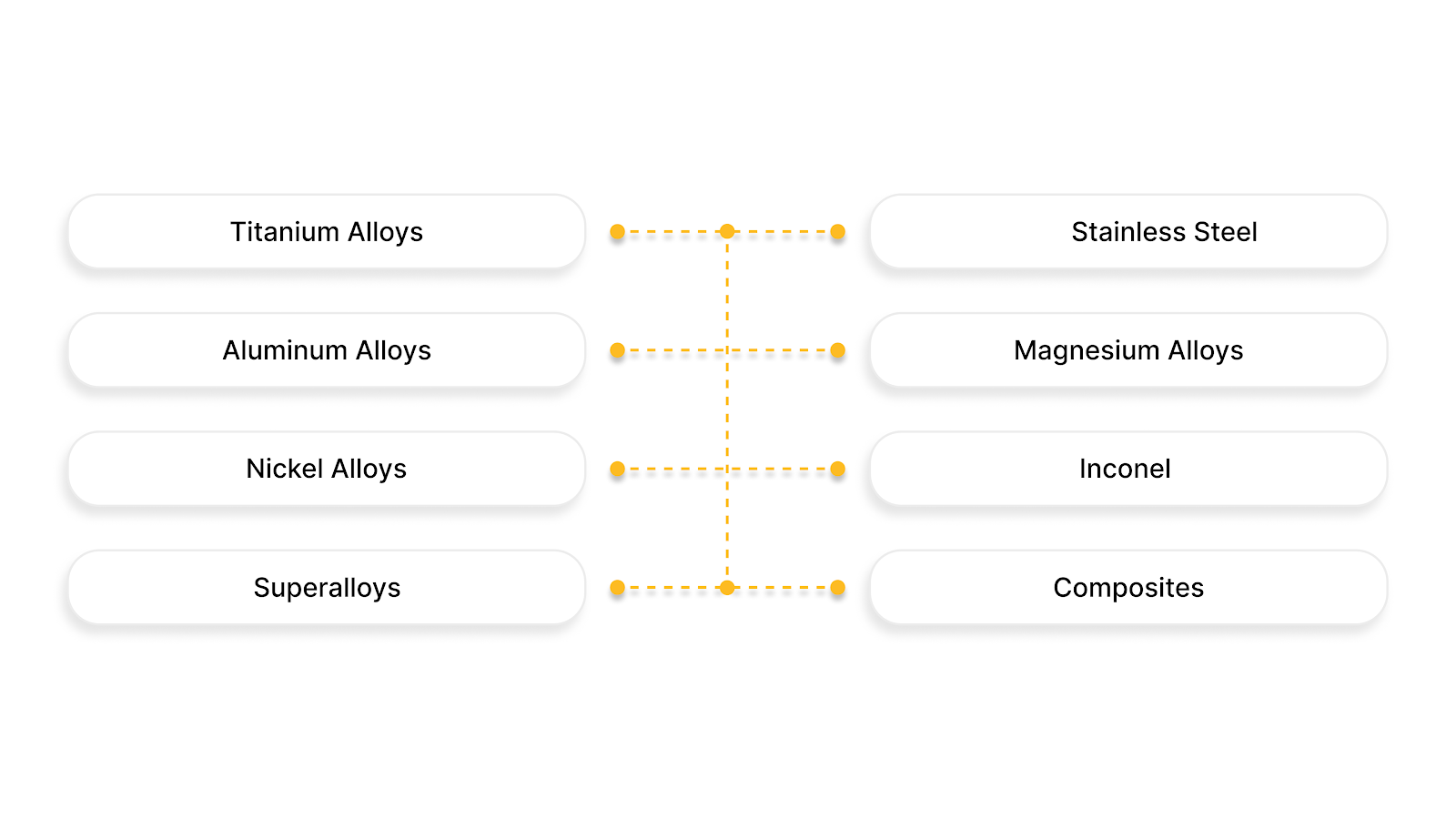
In aerospace manufacturing, selecting the right metal alloys is essential for ensuring high strength, lightweight properties, and corrosion resistance. Below are some of the most common materials used in aerospace:

1. Titanium Alloys

Titanium alloys, particularly Ti-6Al-4V, are valued for their lightweight, high strength, and corrosion resistance, especially in extreme environments.
Applications:

  • Landing gear: High impact resistance and strength without excessive weight.
  • Engine components: Turbine blades, disks, and casings in jet and rocket engines.
  • Cryogenic components: Ti-3Al-2.5V resists extremely low temperatures, ideal for aerospace parts exposed to cryogenic environments.

2. Stainless Steel

Stainless steel is renowned for its corrosion resistance and high-temperature resistance. It is widely used in applications that require both durability and machinability.
Applications:

  • Landing gear: Provides shock absorption and impact resistance during landings.
  • Engine components: Withstands high heat and corrosive chemicals in turbine engines.
  • Joints and fasteners: Often used in critical connections due to their strength and corrosion resistance.

3. Aluminum Alloys

Aluminum alloys are widely used in aerospace for their light weight, corrosion resistance, and ease of machining, making them suitable for a wide range of applications.
Applications:

  • Fuselages: Often used as the outer skin due to their strength-to-weight ratio.
  • Wings: Provides structure to components like stringers and spars.
  • Fuel tanks: Known for corrosion resistance and ease of machining for precision.
  • Support structures: Used in interior components, like seat frames and overhead bins, due to their high strength-to-weight ratio.

4. Magnesium Alloys

Magnesium alloys are lightweight yet strong, commonly used in non-structural parts to reduce overall weight.
Applications:

  • Non-structural components: Used in areas where minimizing weight is critical, but strength remains necessary.

5. Nickel Alloys

Nickel alloys offer exceptional strength even in extreme temperatures and have outstanding resistance to oxidation and corrosion.
Applications:

  • Jet engines: Key components like turbine blades and combustion chambers are made from nickel alloys.
  • Exhaust systems: Resists high temperatures and corrosive gases found in exhaust systems.
  • Wings: Used in durable wing components exposed to high stresses and extreme conditions.

6. Inconel 

Inconel, part of the nickel-based superalloy family, excels in high-temperature environments. It resists corrosion, oxidation, and creep, making it ideal for critical aerospace components.
Applications:

  • Engine parts: Turbine blades, compressor blades, and other components exposed to extreme heat and stress.

7. Superalloys

Superalloys like Hastelloy and Waspaloy are designed to withstand extreme temperatures, high mechanical stresses, and corrosion. These materials are used in parts exposed to the harshest operating environments.
Applications:

  • Jet engines: Components like combustion chambers, turbine sections, and exhaust systems.
  • Spacecraft parts: High-performance alloys resist the extreme conditions of space.

8. Composites

While not a metal, composite materials such as carbon fiber and resins are widely used in aerospace for their lightweight and strength.
Applications:

  • Structural components: Widely used in both interior and exterior components of aircraft and spacecraft, contributing to weight reduction without sacrificing strength.

Each of these materials offers specific advantages that make them crucial in aerospace manufacturing, from resisting high temperatures to ensuring structural integrity under extreme conditions. 

At Aero-Vac Alloys & Forge, we provide a wide range of aerospace-grade alloys, including Hastelloy, titanium, stainless steel, and nickel-based alloys. Our certified, traceable materials and value-added services, such as forging, heat treating, and precision cutting, ensure fast, reliable delivery for mission-critical applications.

Having covered the common metals, it's important to understand why these alloys are challenging to machine and how the industry handles this.

Why Are Aerospace Alloys Challenging to Machine?

Aerospace alloys such as nickel-based superalloys, titanium, and high-strength steels are essential for extreme conditions but pose significant machining challenges due to their unique properties.

Key Challenges in Machining Aerospace Alloys

  • High Hardness and Strength: Alloys such as Inconel and titanium have high strength and hardness, requiring specialized tools and machinery due to the high cutting forces involved.
  • Work Hardening: Alloys like Inconel and stainless steel work-harden during machining, increasing material hardness and making it progressively harder to machine, especially under stress.
  • Excessive Tool Wear: These alloys cause rapid tool wear, requiring frequent tool replacement, which increases costs and slows production.
  • Low Thermal Conductivity: Inconel and titanium have poor thermal conductivity, trapping heat in the cutting zone and causing overheating, warping, and premature tool wear without proper cooling.
  • Increased Machine Wear: High forces and stresses can damage machining equipment, leading to more frequent maintenance and shorter equipment lifespans.
  • Tight Tolerances and Surface Finishes: Achieving precise tolerances and high-quality finishes is difficult due to material properties that cause work hardening and thermal buildup during machining.

Successfully machining aerospace alloys requires a combination of specialized tools, skilled operators, and advanced techniques to overcome the inherent challenges these materials pose.

Now that we’ve seen the machining challenges, let’s consider the crucial factors to keep in mind when selecting aerospace alloys.
Aerospace Metals: Key Considerations

Aerospace Metals: Key Considerations

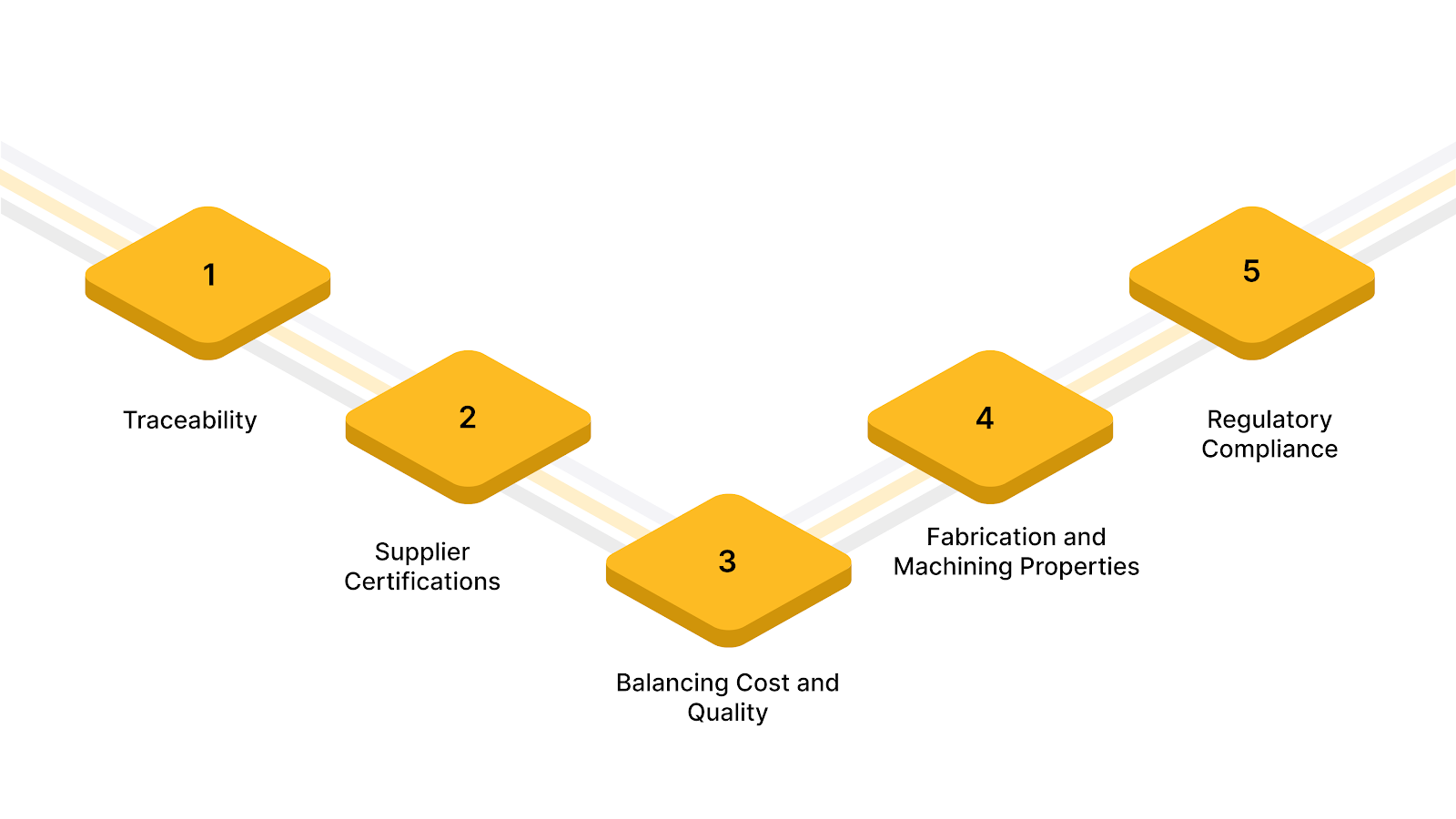
Selecting the right metals for aerospace projects is a critical decision that affects the longevity, safety, and overall performance of components. Here are key factors to keep in mind when sourcing materials:

  • Traceability: Ensure all materials are fully traceable, from mill test reports to final distribution. This verifies material quality and compliance with industry standards, reducing risk and ensuring reliability.
  • Supplier Certifications: Choose suppliers that hold recognized certifications, such as ISO 9001. These certifications ensure that materials meet global quality standards, giving you confidence that your metals will perform as expected.
  • Balancing Cost and Quality: While high-quality alloys may have a higher upfront cost, they provide longer lifespans and reduced maintenance. The higher initial investment is offset by fewer replacements and lower operational costs.
  • Fabrication and Machining Properties: Choose metals that are easy to fabricate while maintaining their integrity. Alloys with good weldability, formability, and machinability are ideal for complex aerospace parts that require precision.
  • Regulatory Compliance: Ensure your materials meet FAA (Federal Aviation Administration) and EASA (European Union Aviation Safety Agency) regulations for safety and quality. 

By carefully considering these factors, aerospace engineers can make well-informed decisions that ensure performance and cost-effectiveness throughout the project’s life cycle.

Also Read: Alloy Forge Explained: Proven Techniques & Applications in 2026

With those considerations in hand, let’s wrap up by discussing why choosing the right partner is just as important as choosing the right materials.

Why Aero-Vac Alloys & Forge is the Trusted Partner for Aerospace Alloys

When selecting special alloys for aerospace applications, performance and reliability are non-negotiable. Aero-Vac Alloys & Forge is the trusted partner in providing high-performance alloys designed to thrive in corrosive environments and high-stress applications. Here’s why we stand out:

  • Certified Quality & Full Traceability: As an AS9100D/ISO 9001-certified company, we provide certified, traceable materials that comply with AMS, BMS, and MIL-STD specifications. 
  • Corrosion-Resistant Alloys: With over 150 aerospace-grade alloys, including nickel-based alloys, titanium, and stainless steels, our materials are designed to resist the harshest corrosive environments, ensuring long-term durability.
  • Fast & Reliable Fulfillment: We understand the urgency in aerospace manufacturing. We deliver custom orders in 2–4 weeks, and next-day shipping is available for in-stock materials, ensuring you stay on schedule.
  • Comprehensive Alloy & Processing Solutions: As a one-stop supplier, we offer value-added processing services, including open-die forging and precision cutting, delivering near-net-shape components ready for final assembly.
  • Minimize Risk, Maximize Performance: Our high-performance alloys are specifically chosen to reduce supply chain risks and boost operational efficiency in aerospace. 

Trust Aero-Vac Alloys & Forge to meet your aerospace alloy needs, delivering certified, corrosion-resistant materials that ensure reliability and performance.

Conclusion

Choosing the right aerospace alloys is critical to ensuring the reliability and performance of components used in high-stakes applications like aerospace, defense, and medical manufacturing. With specialized materials such as Inconel and nickel-based alloys, it's vital to work with a supplier that provides high-quality materials through efficient processing and delivery.

Aero-Vac Alloys & Forge stands out as the go-to partner for these industries, offering certified materials with fast, reliable delivery and essential in-house services such as precision cutting, heat treating, and forging. 

Contact us to help you meet your critical production goals with minimal risk and maximum performance.

FAQs

1. What are the most common aerospace alloys?

Titanium, Inconel, and nickel-based alloys are commonly used for their strength, corrosion resistance, and high-temperature performance.

2. Why are aerospace alloys hard to machine?

Their high hardness, tendency to cold harden, low thermal conductivity, and rapid tool wear make machining aerospace alloys challenging.

3. What factors impact aerospace alloy selection?

Consider corrosion resistance, strength, thermal stability, and machinability to match the alloy's properties with application needs.

4. How do temperature and corrosion affect aerospace alloys?

Extreme temperatures and corrosion impact alloys' performance. Inconel withstands heat, while nickel alloys excel in resisting corrosion, crucial in demanding applications.

5. What is the role of machining in aerospace component production?

Machining shapes aerospace components precisely but requires high-quality tools and careful control to manage tool wear and material properties.

Related articles

8 min read

How Stainless Steel Products Are Manufactured: A Detailed Process Guide

Learn how stainless steel products are manufactured, from raw materials and melting to forming, finishing, and quality checks used in industrial applications.

Learn more
8 min read

Steel Fabrication Quality Control: What Top Manufacturers Get Right

Learn how steel fabrication quality control works, from inspections and testing to traceability and process checks that reduce rework, delays, compliance risk.

Learn more
8 min read

Alloy Quality Control: How to Ensure Consistent Metal Performance

Learn the importance of alloy quality control in ensuring consistent metal performance. Discover techniques for maintaining alloy integrity in manufacturing.

Learn more